White Vinegar For Cleaning Carpets
When you read some blogs about do-it-yourself (DIY) carpet cleaning, some of them mention that vinegar works for everything, while others warn you to use it cautiously since it may ruin your carpet, once and for all. From this point, it is natural for you to think that cleaning your home carpet can be confusing.
Vinegar can help in some cases — but it can also permanently damage carpets if used incorrectly. But don’t bother yourself too much since you’ve come to the right place. This guide will make it clear whether you can use vinegar and step by step, with practical application examples you can try at home.
Table of Contents
Is Vinegar Safe for All Carpet Types?
That is the million-dollar question, and the answer is: yes, generally, vinegar can be used on some synthetic carpets, when diluted correctly and patch-tested first. Nylon and polyester are among the best when you dilute the vinegar solutions correctly.
But there are some warnings if your carpet is made of natural fibres (wool, jute, hemp, sisal, etc.). Since vinegar is an organic compound that is acidic in nature, even in small amounts, it can weaken, fade, or cause patchiness on natural fibres.
From the characteristics explained above, there are several essential tips that you should understand so that using vinegar can be beneficial and effective in cleaning carpets using DIY approaches:
What Vinegar Can Realistically Achieve on Carpet
Although you can use this on certain types of carpet fibre, it doesn’t mean it can solve every problem. You can use it for just light deodorising and lifting fresh, water‑based marks/spills.
White vinegar, which is usually intended for kitchen use, has mild acidity – it’s only suitable for helping you neutralise some smells and loosen specific residues without leaving sticky traces. Hence, it is not ideal for use on more hazardous cleaning scales.
What Vinegar Cannot Fix
What you always have to keep in mind is that it is not a universal cleaner. Various stains containing organic substances, such as oil, protein, and waxes, cannot be removed by it. In addition, its acidic content makes it impossible to remove stubborn, long-standing stains that have set in at a deeper layer.
Therefore, forget about using vinegar if what you have to deal with is hazardous contamination that can leave clear stains and strong odours, such as grease, vomit, urine, faeces, blood, or other bodily fluids – man-made or pet accidents.
When to Avoid Vinegar Entirely
Based on the explanation above, it can be concluded that there are several points of exception to the use of vinegar in some types of daily scenarios, as follows:
When the carpet is made of a natural fibre
- Why vinegar fails: Natural fibre reacts poorly to any acidic solutions, even in small concentrations. It can weaken the fibre’s integrity.
- Cautions: It can cause fibre brittleness, texture changes, patchiness, and colour fading.
- Better alternatives: Use dish soap or any detergent that won’t harm natural fibres and is specifically designed for them.
When the stain contains oil or protein and has a contamination property
- Why vinegar fails: The acidity amount cannot penetrate or neutralise such hazardous substances.
- Cautions: Vinegar doesn’t have enough dissolving capacity and also can’t prevent the growth of microorganisms that cause disease or illness.
- Better alternatives: Use enzyme cleaners or a specialised degreaser with disinfectant properties for tackling hazardous materials – better industrial or hospital grade.
When the spill has penetrated deeply
- Why vinegar fails: The stubborn, deep-set stains sit in the padding or deeper layer, not on the surfaces.
- Cautions: Using vinegar to treat such issues can even cause new problems, such as worsening stained spots, over-spraying it, and inducing new odours.
- Better alternatives: Steam carpet cleaning (hot-water extraction) performed by professionals using specialised equipment delivers far better and safer results. If you’d like to learn more about how steam carpet cleaning works and when it’s most effective, you can read our detailed guide here: https://hypercarpetcleaning.co.nz/what-is-steam-carpet-cleaning/
How to Clean Carpets with White Vinegar: The Correct Method
After understanding the scenarios under which you should use or avoid vinegar in DIY carpet cleaning, you should also know the correct way to do it. First of all, the mixture. You can mix it with warm or room-temperature water in a 1:2 ratio.
If you already have enough of the solutions, with a few white clean cloths, a spray bottle, and a basin full of clean water, follow these steps to get a more effective cleaning:
Step 1: Patch‑test the diluted mixture in a hidden area
- Why this matters: Even if you’ve ensured yours is made of synthetic materials rather than natural ones, some carpet materials still react differently to vinegar solutions because of their acidic-tolerant properties.
- What to look for: Try it in areas or spots on the corner, where furniture usually covers. If, after trying it, you can see colour changes, fibre roughness, or bleaching, this is a sign of unsuitability. So, avoid further use.
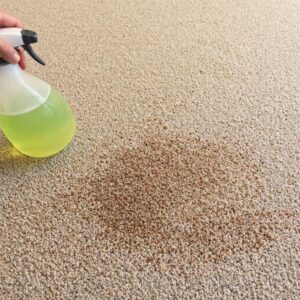
Step 2: Apply lightly rather than soaking the surface
- Why this matters: Over-wetting will push the vinegar solution into the carpet’s deeper layers. If any moisture remains, it will cause an unpleasant odour.
- What to look for: Use this only on narrow areas/spots, since broad applications will increase drying time and cause uneven texture. Always do fine mists only to give more control and wide pooling.
Step 3: Blot with a plain white cloth to avoid dye transfer
- Why this matters: When damped with vinegar solution, coloured cloth may bleed dye – adding new stains to the carpet instead of removing the earlier ones.
- What to look for: Do it by pressing the white cloth firmly, then lift and rotate it. Repeat it several times until you feel enough. By blotting, you can absorb the stain. Never rub it, since it can spread the stain to surrounding clean areas/spots.
Step 4: Rinse the area with a small amount of clean water
- Why this matters: Rinsing it with clean water can remove any leftover vinegar acidity, which can actually make the areas/spots sticky – attracting dirt as the carpet dries.
- What to look for: After you have finished blotting with vinegar solutions, use a new, white cloth dampened with water to blot the area/spots again. Don’t wet the cloth too much, just enough to make it slightly damp.
Step 5: Dry thoroughly to minimise lingering odours
- Why this matters: Not only does it cause a musty smell, but the remaining moisture trapped in the carpet’s layer can become an ideal growing ground for mould and mildew.
- What to look for: Before touching or returning to normal use, ensure the area is completely dry. To speed up and optimise the process, you can open a window, use a fan, or a dehumidifier – especially if it’s raining or the humidity level is high.
Alternatives When Vinegar Isn’t Enough
Using a vinegar solution is only helpful in specific conditions. When vinegar doesn’t work, another organic ingredient you can use is baking soda. You can sprinkle it on the carpet before vacuuming to neutralise mild odours.
While you can use it as a DIY carpet maintenance routine, it cannot replace proper carpet cleaning, which is usually performed by professional carpet cleaners. For more challenging issues, you can ask them to perform hot-water extractions or steam cleaning.
Need a Safer, More Effective Solution? Call Hyper Carpet Cleaning Christchurch
For carpets affected by stubborn stains, deep odours, or delicate fibres that react poorly to vinegar, Hyper Carpet Cleaning Christchurch offers a safer, more thorough alternative. Using the most advanced equipment and fibre-safe cleaning methods, our professional carpet cleaning Christchurch team can resolve carpet issues in a matter of hours—delivering a cleaner, fresher, longer-lasting result without risking damage.